Home / Guides / What size luggage for international travel
Guide
What size luggage for international travel
Limits change; confirm with your airline before you fly. Every figure here links to the airline page it came from.
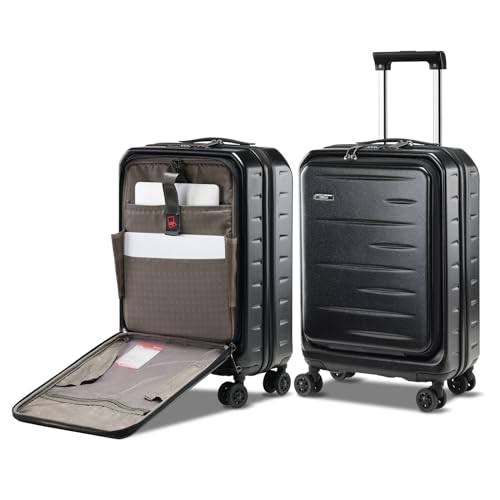
CENSIEN 20 Inch Carry On Luggage 22×14×9 Airline Approved with Front Pocket
21.46 x 13.78 x 8.66 in, wheels and handles included; 6.5 lb listed
At 21.46 x 13.78 x 8.66 inches with wheels included, this bag clears the common US figure, the common mainland European figure and most of the Middle East and Asia-Pacific carriers in this guide's data, which matters most on a trip that connects between airlines with different published limits.
$74.99 Check price on Amazon
Prices change often.
Why does a bag sized right for a US flight sometimes fail on the international leg?
Most US carriers in this guide's data publish 22 x 14 x 9 inches for a carry-on. Once a trip crosses into Europe, the Middle East or Asia-Pacific, the operating airline may publish its limit in centimeters, at a different figure, or with a lower weight cap that US carriers usually do not publish at all. A bag that comfortably clears the outbound US domestic connection can still come up short on the international carrier operating the actual overseas leg.
What size actually clears both a US leg and a European leg?
Mainland Europe's most common published figure, 55 x 40 x 23 cm, converts to about 21.7 x 15.7 x 9.1 inches, used by Lufthansa, Swiss, Turkish Airlines and Wizz Air. That is close enough to the common US figure that a bag built to clear the tighter of the two, roughly 21.5 x 14 x 9 inches, clears both. The guide to the size that fits the most airlines works through the full arithmetic across every airline in this data set, including the outliers that neither figure covers.
| Region | Common carry-on limit | Common personal item limit |
|---|---|---|
| US full-service (American, Delta, United, Alaska, JetBlue, Hawaiian) | 22 x 14 x 9 in | 17 to 18 x 13 to 14 x 8 in where published |
| US ultra-low-cost (Spirit, Frontier, Allegiant) | 22 x 16 to 18 x 10 in | 18 x 14 x 8 in |
| Mainland Europe (Lufthansa, Swiss, Turkish Airlines, Wizz Air) | 55 x 40 x 23 cm (about 21.7 x 15.7 x 9.1 in) | 40 x 30 x 15 cm (about 15.7 x 11.8 x 5.9 in) |
| Middle East (Emirates, Qatar Airways) | 21.6 x 14.9 x 8.6 in or 20 x 15 x 10 in; 7 kg cap | Not confirmed for economy on the page this data draws from |
Do personal item sizes change internationally too?
Yes, in a way that is easy to miss. American Airlines, Spirit, Frontier, Allegiant and Breeze all publish a personal item around 17 to 18 x 13 to 14 x 8 inches in the US. Several European carriers publish a smaller figure, 40 x 30 x 15 cm, which converts to about 15.7 x 11.8 x 5.9 inches, roughly 2 inches shallower than the common US personal item depth. A bag built to the US figure can be too deep for that smaller international allowance.
Does the checked bag weight standard change internationally?
The number itself, 23 kg or 50 lb, stays largely the same across US, Canadian, European and several Asia-Pacific carriers in this guide's data. What changes is which unit gets used in practice: several European carriers, including Lufthansa, KLM, Swiss and Virgin Atlantic, publish only a kilogram figure with no pound equivalent, so a US traveler used to thinking in pounds needs to convert rather than assume the number stays 50.
What about ultra-low-cost international carriers like Ryanair or Wizz Air?
These carriers publish notably tighter and more complicated rules than most full-service international airlines: Ryanair's included cabin allowance is a small under-seat bag only, with the larger bag a paid add-on, and Wizz Air measures its bag without wheels or handles attached. The dedicated guide to ultra-low-cost airline bag rules covers each of these carriers individually, since a single 'international' figure does not describe them well.
What is the practical recommendation for a trip that crosses borders?
Check the specific airline operating the international leg directly, since that carrier's own published limit is what actually governs boarding, not a general assumption about 'international size.' A bag sized close to 21.5 x 14 x 9 inches or smaller, with the wheels and handle included in that figure, clears the large majority of both US and international carriers in this guide's data and is a reasonable single bag to build a trip around.
Gear for this
 $48.00Check price
 $77.16Check price
 $131.99Check price
 $413.99Check price
Frequently asked questions
Will a carry-on sized for US flights definitely work in Europe?
Often, but not always. The common US figure, 22 x 14 x 9 inches, is close to but slightly larger than the common mainland European figure, about 21.7 x 15.7 x 9.1 inches converted from 55 x 40 x 23 cm. Whether a specific US-sized bag clears a specific European limit depends on its exact width and height, so check the operating carrier rather than assuming.
Do I need a different bag if my international flight connects through a different airline?
Not a different bag, but a different check. Compare the same bag's own sorted dimensions against each airline on the itinerary separately, since a connecting flight can be operated by a carrier with a tighter or differently measured limit than the first leg. A bag that clears the strictest airline on the itinerary will clear the others too.
Is the personal item size different on international flights?
Often smaller than the common US figure. Several European carriers publish 40 x 30 x 15 cm, about 15.7 x 11.8 x 5.9 inches, for a personal item, roughly 2 inches shallower than the 8 inch depth common on US airlines. A personal item bag bought for US travel can be too deep for that international figure.
Should I buy a bag with both inch and centimeter markings?
It helps, since international carriers in this guide's data mostly publish limits in centimeters and kilograms, while US carriers publish in inches and pounds. A bag or a scale that shows both units removes a conversion step at the counter, though the sorted-comparison method works the same regardless of which unit is printed on the tape measure.
Researched, not professional advice. Airline rules change; confirm with your airline before you fly.