Home / Comparisons / US vs European carry-on size
Comparison
US vs European carry-on size
 Best for US carry-on limits
Wrangler 22" Hardside Spinner Carry-On Luggage
22 x 14 x 9.5 in with wheels, 6.4 lb$54.09Check price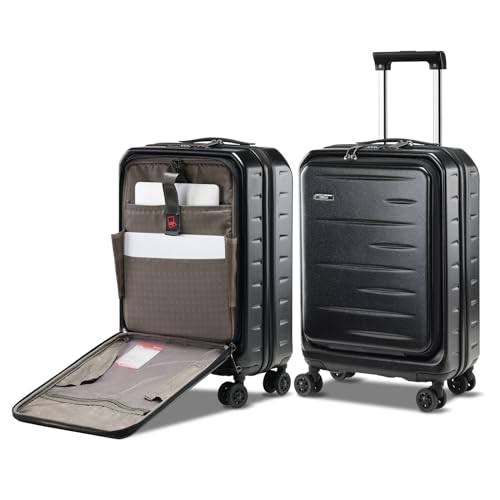 Closest fit to European limits
CENSIEN 20 Inch Carry On Luggage 22×14×9 Airline Approved with Front Pocket
21.46 x 13.78 x 8.66 in with wheels, 6.5 lb$74.99Check price
| Airline | Size | Weight limit |
|---|---|---|
| American Airlines (US) | 22 x 14 x 9 in (56 x 36 x 23 cm) | Not published |
| Delta (US) | 22 x 14 x 9 in, 45 linear in max (56 x 35 x 23 cm) | Not published |
| JetBlue (US) | 22 x 14 x 9 in (55.9 x 35.6 x 22.9 cm) | JetBlue states no weight limit currently applies |
| Lufthansa / Swiss / Turkish Airlines (Europe) | 55 x 40 x 23 cm (21.7 x 15.7 x 9.1 in) | 8 kg (about 17.6 lb) |
| Air France / KLM (Europe) | 55 x 35 x 25 cm (21.7 x 13.8 x 9.9 in) | 12 kg (about 26.5 lb), covers the cabin bag and personal item combined |
| Ryanair (Europe) | 55 x 40 x 20 cm (21.7 x 15.7 x 7.9 in), Priority fare only | 10 kg (about 22 lb) |
| easyJet (Europe) | 56 x 45 x 25 cm (22 x 17.7 x 9.8 in), paid add-on | 15 kg (about 33 lb) |
What's the actual size difference between US and European carry-on rules?
US full-service carriers converge on almost the same box: 22 x 14 x 9 in, which converts to 55.9 x 35.6 x 22.9 cm. European carriers publish their limits natively in centimeters and land in two common shapes instead, 55 x 40 x 23 cm (Lufthansa, Swiss, Turkish Airlines and others) and 55 x 35 x 25 cm (Air France, KLM). Both European shapes are close to the US figure in overall volume but distribute the dimensions differently, generally wider or deeper and slightly shorter in height.
Why do US airlines skip a weight limit while European ones enforce one?
None of American, Delta, United or Alaska publish a weight limit for carry-on bags on the pages checked for this site, and JetBlue explicitly states it currently has no weight restriction at all. European carriers almost universally attach a weight cap to the size limit instead, commonly 7 to 12 kg (about 15 to 26 lb), and some, like Air France and KLM, count your personal item's weight against that same total rather than giving it a separate allowance.
Does a bag that clears US airlines automatically clear Europe?
Not always. A US-standard 22 x 14 x 9 in bag has a height of 9 in, which is 22.9 cm, and that clears the common 23 cm European height cap used by Lufthansa, Swiss and Turkish Airlines with almost no margin, and clears the 25 cm caps used by Air France, KLM and easyJet more comfortably. It does not clear Ryanair's tighter 20 cm height limit on its free personal item tier, or fit within Ryanair's paid 55 x 40 x 20 cm Priority bag allowance at all, since 9 in is meaningfully taller than 20 cm (7.9 in).
Which airlines use centimeters as the official measurement?
Every European carrier in this comparison, Lufthansa, Air France, KLM, Swiss, Ryanair, easyJet, Turkish Airlines and others, publishes centimeters as the primary unit, with inches sometimes given as a rounded conversion or left out entirely. See the full airline-by-airline breakdown at /reference/european-carry-on-size-chart/ before converting a US bag's inch measurements yourself.
What's a safer single bag size if you fly both regions?
A carry-on with a with-wheels footprint closer to 21.5 x 13.8 x 8.7 in, like the CENSIEN 20 Inch listed in this catalog, has a lower profile at roughly 22 cm (8.66 in) tall, comfortably under the common 23 cm European height cap, though it still exceeds Ryanair's tighter 20 cm limit. No single bag in this catalog clears every European carrier's tightest limit, so if you fly Ryanair or a similarly strict carrier regularly, plan on its personal item allowance instead of a full carry-on.
The verdict
If you fly mostly US airlines, a standard 22 x 14 x 9 in carry-on with no weight limit worry is the safe default. If you regularly fly European carriers too, favor a bag with a lower listed height, closer to 22 cm than the full 23 cm US-equivalent figure, and always check the specific carrier's weight cap, since 7 to 12 kg limits catch far more travelers off guard than the size limit itself.
Shop both sides
 $48.00Check price
American Tourister Stratum 3.0 Carry-On Spinner
22 x 15 x 9.5 in with wheels, 7.3 lb$77.95Check price $131.99Check price
 $413.99Check price
Frequently asked questions
Is a 22 x 14 x 9 inch carry-on accepted in Europe?
Often yes, but not universally. That size converts to 55.9 x 35.6 x 22.9 cm, which clears the common 55 x 40 x 23 cm and 55 x 35 x 25 cm European limits used by carriers like Lufthansa, Air France and KLM with little to no margin. It does not clear Ryanair's tighter 55 x 40 x 20 cm Priority bag allowance, since its height exceeds Ryanair's 20 cm cap.
Do European airlines actually weigh carry-on bags at the gate?
Many do enforce their published weight cap, especially ultra-low-cost carriers like Ryanair, Wizz Air and easyJet, which commonly weigh bags at the gate or bag drop and charge a fee for anything over the limit. US full-service airlines generally do not publish or enforce a carry-on weight limit at all, which is one of the biggest practical differences between the two regions.
What is the smallest common European carry-on size limit?
Among the carriers checked here, Ryanair's free personal item and its paid Priority carry-on both cap out with a 20 cm height limit, the tightest in this comparison. Its full Priority bag allowance is 55 x 40 x 20 cm with a 10 kg weight cap, noticeably shorter than the 23 cm or 25 cm height caps most other European carriers use.
Why do some European airlines charge for a carry-on that US airlines include free?
Ultra-low-cost European carriers like Ryanair and easyJet often include only a small under-seat personal item for free and sell the larger overhead-bin bag as a paid add-on, similar to how Spirit and Frontier operate in the US. Full-service carriers on both continents, like American, Delta, Lufthansa and Air France, typically include both a carry-on and a personal item in the base fare.
Researched from published specifications and airline pages, not hands-on testing. Not professional advice.