Home / Guides / How to pack a carry-on
Guide
How to pack a carry-on
Limits change; confirm with your airline before you fly. Every figure here links to the airline page it came from.

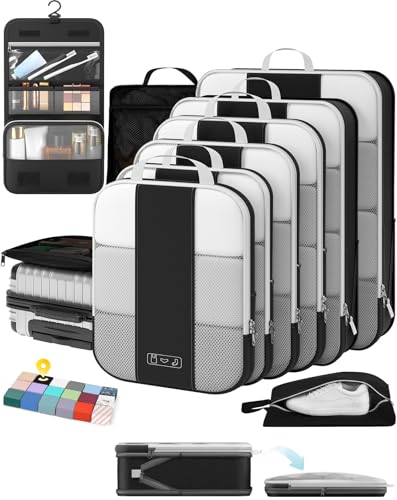
BAGAIL 8 Set Packing Cubes Luggage Packing Organizers for Travel
This BAGAIL 8 piece packing cube set, $16.98, sorts clothing by type or by day, and compresses items slightly inside the cube itself rather than inside the bag's structure, which keeps a full carry-on from bulging past its measured size.
$16.98 Check price on Amazon
Prices change often.
Start with a bag that actually fits the airline being flown
Packing technique only matters once the bag itself is the right size. A bag that is already at or over an airline's published limit before it is packed will not be saved by better packing, since the outside dimensions do not shrink no matter how efficiently the inside is used. Confirm the bag's size against the specific airline first, then focus on how to use the space inside it.
Should clothes go in packing cubes or loose?
Packing cubes group clothing by day, outfit or type, which makes it possible to find something without unpacking the whole bag, and a compression style cube, like the NICOSHOW 6 set (B0BWTHT3L5, $17.81, 12 x 8 x 4 inches per cube as listed), squeezes the air out of soft items like sweaters so more fits in the same volume. Loose clothing is faster to pack in a hurry but tends to shift and settle unevenly, which can leave usable space unused.
- Packing cubes: better for organization and for keeping outfits together
- Compression cubes: better when the bag is genuinely full and something still needs to go in
- Loose packing: fastest, but least efficient use of the bag's interior
Does rolling clothes really save more room than folding?
Rolling tends to use space more efficiently for casual clothing like t-shirts, underwear and casual pants, and it reduces some kinds of creasing. Folding still works better for structured items like blazers or dress shirts that wrinkle badly when rolled. Most people end up doing both in the same bag rather than picking one method for everything.
Where should liquids, electronics and anything fragile go?
Liquids need to be reachable without unpacking the whole bag, since they usually have to come out at a security checkpoint. Electronics are safest padded in the center of the bag, away from the hard shell or the wheel housings, which take the brunt of any drop or rough handling. Anything fragile is safer surrounded by soft clothing than sitting against a hard interior wall.
What about the dead space near the wheels and handle?
The area around the wheel housings and the retracted handle mechanism is usually the least usable part of a hardside bag's interior, but shoes, a rolled belt or a small toiletry bag can still fit into those corners rather than sitting in the main compartment taking up flatter, more useful space.
What if there is not enough room left for the trip home?
Leaving a little slack on the way out, rather than packing completely full, makes room for anything picked up along the way. A packable compression bag, folded flat inside the carry-on on the outbound flight, can hold worn clothing separately on the way home and free up the packing cubes for anything new.
Gear for this
 $16.99Check price
 $19.54Check price
 $29.98Check price
 $104.00Check price
Frequently asked questions
Do packing cubes actually save space, or just organize?
Both, depending on the style. A standard packing cube mostly organizes, keeping clothing sorted and easy to find without changing how much fits overall. A compression style cube, which zips down after being filled, does genuinely reduce the volume soft items like sweaters or jackets take up, which can free up real room in a full bag.
Should heavy items go at the bottom or near the wheels?
Near the wheels, at the base of the bag when it is standing upright, is generally the sturdiest and most stable placement for heavy items like shoes or a toiletry kit, since that section takes the most structural support. Putting heavy items up top can make the bag top-heavy and harder to roll or lift into an overhead bin.
How many packing cubes do I actually need for a one-week trip?
Most travelers use 3 to 5 cubes for a week: one for tops, one for bottoms, one for underwear and socks, and one or two for anything bulkier like a sweater or a pair of shoes. An 8 piece set gives room to separate further by outfit or by day, which is more organization than most one-week trips strictly need but leaves room to spare.
What is the difference between compression cubes and regular packing cubes?
A regular packing cube is a simple zippered pouch that organizes clothing without changing its volume. A compression cube has a second zipper that flattens the contents after the first zipper closes, physically reducing how much space the same clothing takes up, which matters most when a bag is close to full.
Researched, not professional advice. Airline rules change; confirm with your airline before you fly.